Monday, 27 February 2012

Facebook: We're not reading your text messages

Facebook is denying a report from a UK newspaper that it has at some point "admitted to reading text messages" via its mobile apps, and describes the accusation as "creative conspiracy theorizing."
Facebook issued the rebuttal following a Sunday Times story which stated that the social network is accessing user data including text messages via its Android app as part of a testing process for a future messaging service.

In a public statement, Facebook communications manager Iain Mackenzie called the newspaper's claim "another piece of disingenous reporting that does nothing for journalism and confuses users."

According to Mackenzie, Android users accessing the Facebook app receive a prompt requesting permission to access the read/write function for SMS upon install — because the company is currently "running a limited test of mobile features which integrate with SMS functionality" and the presence of such a functionality has to be declared in the app's permissions.

Mackenzie writes that Facebook worked with the Times to explain this situation and process and clarifies that if the relevant functionalities are ever used outside of testing "with people who know exactly what [Facebook is] testing" the company will ensure that it provides "appropriate guidance/educational materials." He adds that Facebook also never claimed to be launching a messenger product. "Any proper technology journalist will tell you that there are any number of things you can use SMS for, such as carrier billing," he writes.

We reached out to Facebook for further comments on the whole matter and while we haven't received a reply yet, a Facebook spokesperson didissue the following statement to The Verge, basically repeating what Mackenzie wrote:

The Sunday Times has done some creative conspiracy theorizing but the suggestion that we're secretly reading people's texts is ridiculous. Instead, the permission is clearly disclosed on the app page in the Android marketplace and is in anticipation of new features that enable users to integrate Facebook features with their texts. However, other than some very limited testing, we haven't launched anything so we're not using the permission. If we do, it will be obvious to users what's happening. We'll keep you posted on our progress.
The Verge's Josh Topolsky added to the statement by suggesting that "it's clear that writers at the [Times] don't have an in-depth understanding of how permissions work for apps. Much of the article seems aimed at drumming up fear, uncertainty, and doubt."
Want more tech news, silly puns, or amusing links? You'll get plenty of all three if you keep up with Rosa Golijan, the writer of this post, by following her on Twitter, subscribing to her Facebook posts, or circling her on Google+.

Sunday, 26 February 2012

How do GPS satellites know where they are?

Our Global Positioning System(GPS) tells us exactly where we are, down to a few metres, but how do satellites that make up the GPSthemselves know where they are?

They have to rely on a network of sites that serve as "You Are Here" signs planted throughout the planet. The catch is, the sites don't sit still because the planet is moving all the time, yet modern measurements require more and more accuracy in pinpointing where "here" is.

Accordingly, NASA is helping to lead an international effort to upgrade the four systems that supply this crucial location information. NASA's initiative is run by Goddard Space Flight Centre, Greenbelt, US, where the next generation of two of these systems is being developed and built.

"In practical terms, we can't determine a location today and expect it to be good enough tomorrow-and especially not next year," says Herbert Frey, who heads the Planetary Geodynamics Lab at Goddard.

And Goddard, in partnership with NASA's Jet Propulsion Lab in Pasadena, Calif., is bringing all four systems together in a state-of-the-art ground station, according to a NASA statement.

"NASA and its sister agencies around the world are making major investments in new stations or upgrading existing stations to provide a network that will benefit the global community for years to come," says John LaBrecque, Earth Surface and Interior Program Officer at NASA Headquarters.

Measuring such properties of Earth is the realm of geodesy, a time-honoured science that dates back to the Greek scholar Eratosthenes, who achieved a surprisingly accurate estimate of the distance around the Earth by using basic geometry.

iOS 86

What makes the iPhone so amazing has a lot to do with its iOS which gives it a very attractive and user-friendly interface. Now what would the iPhone look like if it used the OS that the original Macs from the 80s had? Check out these amazing conceptual renderings to find out.

Apple iPhone iOS 86

The iOS ’86 concept by Anton Repponen wonderfully re-imagines the default iOS home screen in the style of the original Mac OS, down to the classic Chicago bitmap font. It’s a neat idea that almost makes me wish I could skin my iPhone’s beautiful 960×680 screen with an old low-resolution GUI—just to see if it looks this nice in real life.

Black and white iPhone iOS

80s Apple OS

Classic Apple iOS iPhone skin

It’s still a concept so could be a great opportunity for someone to come up with an actual iPhone theme or skin, based on it. via

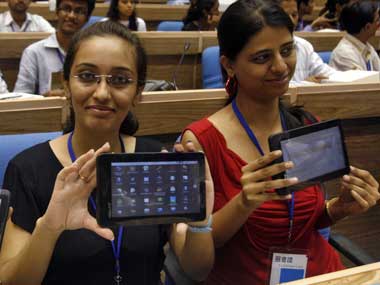
BSNL launches 3 tablets, lowest model priced at Rs 3,250

State-owned telecom services provider BSNL has launched three tablets making a quiet entry into the increasingly competitive market for the hand-held computers.

Recently, Datawind, promoted by a Canadian India, had made a Much-publicised entry into the market in a tie-up with the government to provide cheap networking devices ”Aakash”, priced at Rs 2,250 for students.

The three tablets launched by BSNL are priced at Rs 3,250, Rs 10,999 and Rs 13,500. Two of them come with 7-inch resistive screen with Android 2.3 operating system, while the third comes with an 8-inch touchscreen, a BSNL official said.

BSNL has made a quiet entry into the increasingly competitive market for the hand-held computers. Reuters

Made by Noida-based Pantel, these tablets will be sold with discounted data plans from BSNL, sources said.

According to Pantel, the T-PAD IS701R has 1GHz processor and 256M RAM and is wi-fi enabled. The built-in 2GB memory can be expanded by up to 32GB.
The second model T-Pad WS704C has 512MB DDRIII RAM and can be connected to TV through HDMI.

The costliest model, T-PAD WS802C is powered by a 1.2GHz processor and 512MB DDRIII RAM and also has a built-in Global Position System.

Samsung Galaxy Tab 2 to come in 10-inch model, too | Mobile World Congress

Samsung is readying a slew of slates to unveil at Mobile World Congress, including successors to its original Galaxy Tab.

Samsung Galaxy Tab 2, 10.1-inch model

The Samsung Galaxy Tab 2 serves up Ice Cream Sandwich in 7- and 10-inch sizes.

(Credit: Samsung)

BARCELONA, Spain--There are no secrets with the Samsung Galaxy Tab 2, the successor to the original 7-inch tablet family that Samsung unveiled last year. This Mobile World Congress brings not only a 7-inch version of the Tab 2, but an update to today's 10.1-inch model as well.

Both tablet sizes will feature Android 4.0 Ice Cream Sandwich, a 1GHz dual-core processor, and two cameras, in addition to the usual scoop of Samsung's apps and hubs. While 3G-capable, there will also be Wi-Fi-only versions.

Samsung will launch the Galaxy Tab 2 series in March, beginning with the UK. We don't have U.S. pricing or release date information yet, but our team on the ground will get plenty of hands-on time with the device once Mobile World Congress officially begins on Monday.

We're also looking forward to trying our hand with the Samsung Galaxy Note 10.1, a tablet that includes the S-Pen stylus and stylus SDK of the smaller Samsung Galaxy Note, a jumbo-size smartphone with a 5.3-inch screen that some people are calling a "phablet."


Saturday, 25 February 2012

Android bug opens smartphones to outside control: Experts

Cybersecurity experts have uncovered a flaw in a component of the operating system of Google Inc's widely used Android smartphone that they say hackers can exploit to gain control of the devices.

Researchers at startup cybersecurity firm CrowdStrike said they have figured out how to use that bug to launch attacks and take control of some Android devices.

CrowdStrike, which will demonstrate its findings next week at a major computer security conference in San Francisco, said an attacker sends an email or text message that appears to be from a trusted source, like the user's phone carrier. The message urges the recipient to click on a link, which if done infects the device.

At that point, the hacker gains complete control of the phone, enabling him or her to eavesdrop on phone calls and monitor the location of the device, said Dmitri Alperovitch, chief technology officer and co-founder of CrowdStrike.

Google spokesman Jay Nancarrow declined comment on Crowdstrike's claim.

Alperovitch said the firm conducted the research to highlight how mobile devices are increasingly vulnerable to a type of attack widely carried out against PCs. In such instances, hackers find previously unknown vulnerabilities in software, then exploit those flaws with malicious software that is delivered via tainted links or attached documents.

He said smartphone users need to prepare for this type of attack, which typically cannot be identified or thwarted by mobile device security software.

"With modifications and perhaps use of different exploits, this attack will work on every smartphone device and represents the biggest security threat on those devices," said Alperovitch, who was vice president of threat research at McAfee Inc before he co-founded CrowdStrike.

Researchers at CrowdStrike were not the first to identify such a threat, though such warnings are less common than reports of malicious applications that make their way to online websites, such as Apple's App Store or the Android Market.

In July 2009, researchers Charlie Miller and Collin Mulliner figured out a way to attack Apple'siPhone by sending malicious code embedded in text messages that was invisible to the phone's user. Apple repaired the bug in the software a few weeks after the pair warned it of the problem.

The method devised by CrowdStrike currently works on devices running Android 2.2, also known as Froyo. That version is installed on about 28 per cent of all Android devices, according to a Google survey conducted over two weeks ending February 1.

Alperovitch said he expects to have a second version of the software finished by next week that can attack phones running Android 2.3. That version, widely known as Gingerbread, is installed on another 59 per cent of all Android devices, according to Google.

CrowdStrike's method of attack makes use of a previously unpublicized security flaw in a piece of software known as webkit, which is built into the Android operating system's Web browser.

Webkit is also incorporated into other software programs, including Google's Chrome browser and the Apple iOS operating system for the iPhone and iPad.

CrowdStrike said it had not attempted to create software to attack iOS devices or the Chrome browser.

Manufacturers of Android devices include HTC Corp, LG Electronics Inc, Motorola MobilityHoldings Inc and Samsung Electronics Co.

'India has world's youngest internet population'

India has the world's youngestinternet population with 75 per cent of all users under the age of 35 years, said research firm comScore Friday.

The findings were announced by comScore's co-founder and executive chairman Gian M. Fulgoni at the second edition of digital marketing event 'ad:tech' being organised here.

In comparison to India, the world's average of under 35-year users stood at 52 per cent and 55 per cent in Asia Pacific region.

"Further, a third of India's total online population is between 15 to 24 years," said Fulgoni.

Indian users spent a total of 34.47 billion minutes online last year, which translated to over half a billion hours, he added.

Segment-wise usage has also revealed that 95 per cent of the total online users use social networking sites compared to 82 per cent of the world's online users leveraging social networks.

Among other facts that Fulgoni gave out was that of four minutes spent on social network, three are on Facebook.

"LinkedIn reaches one in eight online users, whereas one in 12 online users are on Twitter in India," Fulgoni said.

"In contrast, use of email and instant messaging is on a decline, especially in the younger age groups. Email usage declined by 22 percent in the 15-24 age segment, and by eight percent among 25-34 age segment," he said.